# Getting started with Pipelines
Welcome to Buildkite Pipelines, a secure, scalable, and flexible platform for building CI/CD workflows. This tutorial walks you through the fundamentals in three stages:
1. [Create a new pipeline](#create-a-new-pipeline) from one of the Buildkite-provided examples, to learn the **New Pipeline** page and see how a build runs.
1. [Create your own pipeline](#create-your-own-pipeline) by adding a pipeline definition to your own repository.
1. [Add a test suite](#add-a-test-suite) using [Test Engine](/docs/pipelines/configure/tests) — the testing layer of Buildkite Pipelines — to collect results from your test runners.
## Before you start
> 📘
> This tutorial assumes that you're new to Buildkite Pipelines. To begin, [create a free, personal Buildkite account](https://buildkite.com/signup?iaid=pricing-free).
From the **Start building for free** page, do either of the following:
- Select **Sign up with GitHub** and then **Authorize Buildkite** to access your GitHub account. If prompted with the **Install Buildkite** page in GitHub, select **All repositories** (recommended), or **Only select repositories** to limit the installation scope.
- Select **Continue with Email**, enter your **Full name**, **Email** address, and **Password**, then select **Sign up**.
1. Follow the instructions on the **Verify your email** page and select the verification link in the email sent to that address.
1. On the **Create organization** page, enter a name for your Buildkite organization.
Either path takes you to the **New Pipeline** page, where you can begin [creating your new pipeline](#create-a-new-pipeline).
## Create a new pipeline
A [_pipeline_](/docs/pipelines/glossary#pipeline) is what represents a CI/CD workflow in Buildkite Pipelines. You define each pipeline with a series of [_steps_](/docs/pipelines/glossary#step) to run. When you trigger a pipeline, you create a [_build_](/docs/pipelines/glossary#build), and steps are dispatched as [_jobs_](/docs/pipelines/glossary#job), which are run on [agents](/docs/pipelines/glossary#agent). Jobs are independent of each other and can run on different agents.
If you signed up:
- With GitHub, the **New Pipeline** page's **Git scope** is set to your GitHub account, with its most recently updated repository selected in the **Repository** field. To explore example pipelines instead, select **Or try an example**. If your GitHub account has no repositories, the **Starter pipeline** of the **Buildkite Examples** is selected automatically.
- By email, the **New Pipeline** page presents the **Starter pipeline** of the **Buildkite Examples**.
### Understanding the New Pipeline page
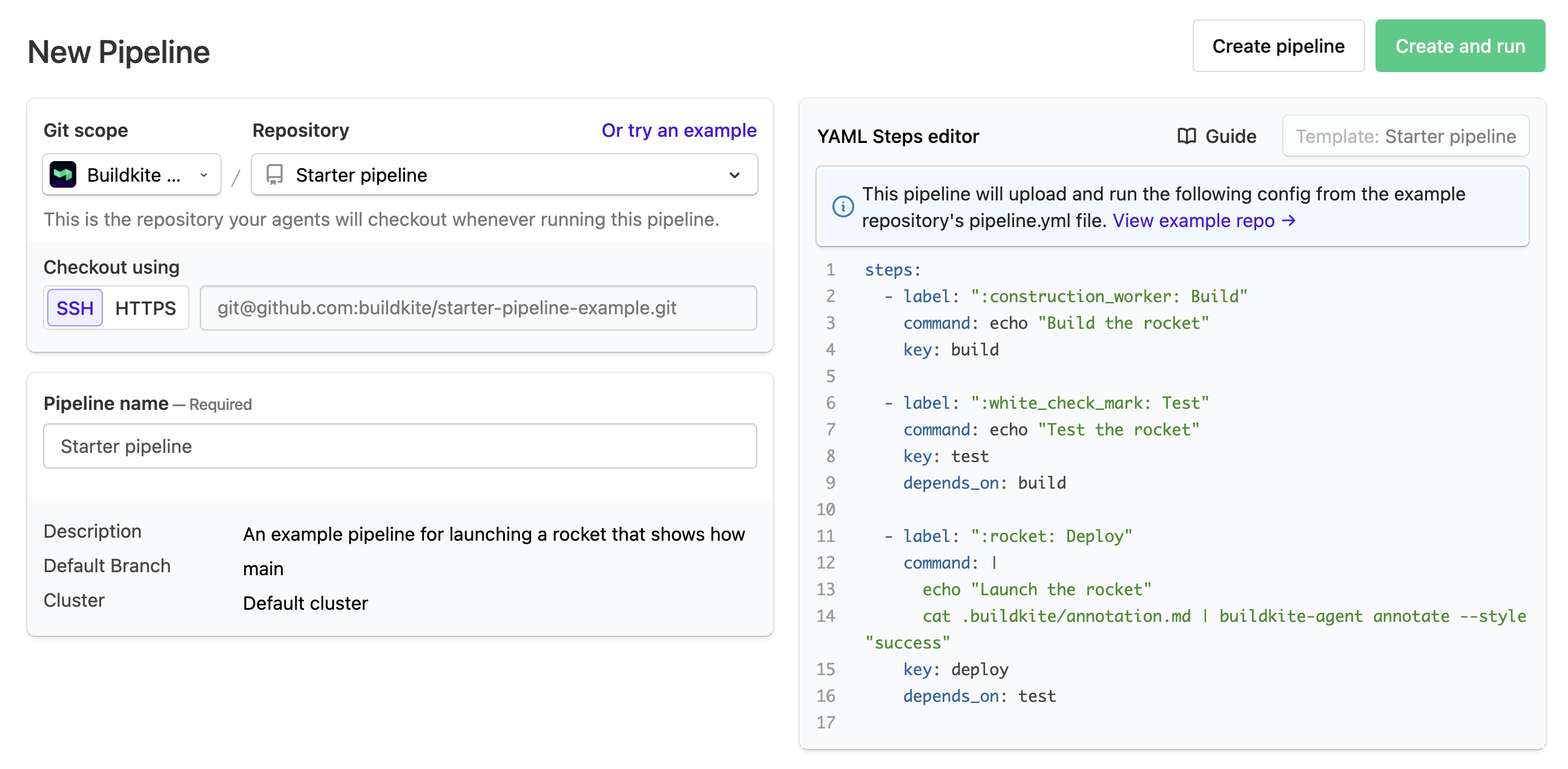 The **New Pipeline** page has the following fields:
- **Git scope**: Select from these options:
* Your GitHub account or organization.
* **Buildkite Examples**, which build projects across a variety of use cases.
* **Use remote URL** for **GitLab**, **Bitbucket**, or **Any account**, for any other remotely accessible Git repository. The **Manage accounts** option configures connections to these repository providers. See [Source control](/docs/pipelines/source-control) for more information.
* **Connect GitHub account**, useful if you signed up by email and need to connect your GitHub account—this generates the [same **Install Buildkite** step as in the GitHub sign-up process](#before-you-start).
- **Repository**: Select the Git repository available to your selected **Git scope**. Upon selection:
* The **Checkout using** option appears, where you can select **SSH** or **HTTPS**.
* For non-**Buildkite Examples** repositories, the **Build Triggers** section may appear, showing the actions that trigger a build. Clear the **Trigger builds when** checkbox to disable triggering.
- **Pipeline name**: Auto-generated from your repository's name; change it here if needed.
- **Description** ( _optional_ ): A description shown under the pipeline name on the main **Pipelines** page.
- **Default Branch**: The branch your pipeline builds by default. Leave unchanged for this tutorial.
- **Teams**: The Buildkite teams with permission to build your pipeline.
**Note:** If you just [signed up to Pipelines](#before-you-start), this field won't appear until [teams](/docs/platform/team-management) are configured. If shown, leave it unchanged for this tutorial.
- **Cluster**: The Buildkite cluster whose agents build your pipeline. Leave unchanged for this tutorial.
- **YAML Steps editor**: Define steps for your main Buildkite pipeline. To start, pick an initial pipeline from the **Template** dropdown:
* **Helper templates**:
- **Hello world**: A simple example of command syntax in Buildkite pipeline YAML.
- **Pipeline upload**: Uploads a Buildkite pipeline stored in your repository.
* **Example templates**: Pipelines used to build example projects available from the **Repository** field when **Git scope** is set to **Buildkite Examples**.
> 📘
> If you've already created a pipeline definition at `.buildkite/pipeline.yml` in your selected **Repository**, select the **Pipeline upload** option from the **Template** dropdown of the **YAML Steps editor**. This generates a step that uploads and runs the rest of your pipeline from that file. Learn more in [Create your own pipeline](#create-your-own-pipeline).
### Example pipelines
To build a sample pipeline:
1. Ensure **Buildkite Examples** is selected in **Git scope** and select **Starter pipeline**.
1. In the **YAML Steps editor**, note the three steps (`build`, `test`, `deploy`), their job dependency order, and the annotation-related command in the `deploy` step.
1. Select **Create and run** to create your **Starter pipeline** and run its first build.
1. Once the build completes, check its **Annotations** tab, which displays the content of the repository's `.buildkite/annotation.md` file.
Try creating and building other **Buildkite Examples** that suit the technologies you work with. More example repositories are available from the [Buildkite Resources Examples](https://buildkite.com/resources/examples/) page.
> 📘
> For each **Buildkite Examples** repository, the pipeline shown in the **YAML Steps editor** is retrieved from that repository's `.buildkite/pipeline.yml` file. A Buildkite pipeline commits nothing to your repository unless you explicitly instruct it to.
## Create your own pipeline
This section walks you through writing a pipeline definition for your own code — stored as a `.buildkite/pipeline.yml` file in your repository — and creating a Buildkite pipeline that uploads and runs it. You'll need a repository (real or experimental) and a task to perform with it, such as running tests or a script.
### Define the steps
Steps can do anything from building and testing your code to deploying it. Start simple and iterate, running the pipeline to verify it works as you go.
To define the steps:
1. Decide the goal of the pipeline.
1. Look for an [example pipeline](https://buildkite.com/resources/examples/) closest to that goal, or a [pipeline template](https://buildkite.com/pipelines/templates) for your technology stack, as a starting point.
**Note:** If you have a pipeline defined in another CI/CD platform (GitHub Actions, Jenkins, CircleCI, or Bitbucket Pipelines), use the [Pipeline converter](/docs/pipelines/converter) to convert its syntax.
1. In the root of your repository, create a file named `pipeline.yml` in a `.buildkite` directory.
1. In `pipeline.yml`, define your pipeline steps. Here's an example:
```yaml
steps:
- label: "\:hammer\: Build"
command: "scripts/build.sh"
key: build
- label: "\:test_tube\: Test"
command: "scripts/test.sh"
key: test
depends_on: build
- label: "\:rocket\: Deploy"
command: "scripts/deploy.sh"
key: deploy
depends_on: test
```
See [Defining steps](/docs/pipelines/configure/defining-steps) for customization options.
1. Commit and push this file to your repository.
### Create a pipeline
Next, create a new pipeline that uploads the pipeline definition from your repository:
1. Select **Pipelines** to navigate to the [Buildkite dashboard](https://buildkite.com/).
1. Select **New pipeline**.
**Note:** Use **Git scope** > **Use remote URL** to connect a Bitbucket, GitLab, or other GitHub account. After connecting, select its repositories from the **Repository** dropdown.
1. If you connected an account in **Git scope**, select the **Repository** to use.
1. Enter your pipeline's **Pipeline name** and **Description** (changeable later from settings).
1. In the **YAML Steps editor**, ensure there's a step to upload the definition from your repository. Generate this automatically using the **Pipeline upload** option from the **Template** dropdown:
```yaml
steps:
- label: "\:pipeline\:"
command: buildkite-agent pipeline upload
```
1. Select **Create pipeline**.
1. On the next page, select **New Build**. In the dialog, enter a short **Message** (for example, **My first build**) and select **Create Build**. The build page opens and the build begins.
If you've configured webhooks, your pipeline triggers when you push updates to the repository. Otherwise, select **New Build** in the Buildkite dashboard to trigger it. To add more functionality, edit your steps and repeat. If you have trouble, reach out to support at support@buildkite.com.
> 📘 Pipeline slugs and names
> A pipeline's _slug_ (part of its URL) is [derived from the pipeline's **Name**](#create-your-own-pipeline-deriving-a-pipeline-slug-from-the-pipelines-name). Changing the **Name** also changes the slug, but previous slugs automatically redirect to the current one.
### Using private repositories
When you create a new pipeline with a private repository URL, you'll see instructions for configuring your source control's webhooks. Once you've followed those instructions, ensure your agent's SSH keys are configured for code access (see relevant instructions for [self-hosted](/docs/agent/self-hosted/code-access) or [Buildkite hosted](/docs/agent/buildkite-hosted/code-access) agents) so your agent can check out the repository.
### Deriving a pipeline slug from the pipeline's name
Pipeline slugs are derived from the pipeline name you provide when the pipeline is created (unless you use the optional `slug` parameter to specify a custom slug).
This derivation process involves converting all space characters (including consecutive ones) in the pipeline's name to single hyphen `-` characters, and all uppercase characters to their lowercase counterparts. Therefore, pipeline names of either `Hello there friend` or `Hello There Friend` are converted to the slug `hello-there-friend`.
The maximum permitted length for a pipeline slug is 100 characters.
> 📘
> The following regular expression is used to derive and convert the pipeline name to its slug:
> `/\A[a-zA-Z0-9]+[a-zA-Z0-9\-]*\z/`
Creating a new pipeline with a name that matches an existing pipeline's name results in an error.
## Add a test suite
Once your pipeline runs its test runners, layer [Test Engine](/docs/pipelines/configure/tests) on top to collect, analyze, and manage results. The three steps are:
1. Create a [test suite](/docs/pipelines/configure/tests/test-suites)
1. Configure a [test collector](/docs/pipelines/configure/tests/test-collection) in your project
1. Wire the suite's API token into your pipeline
> 📘 Recommended setup
> The recommended way to set up a new test suite is to add the [Tests Buildkite plugin](https://buildkite.com/resources/plugins/buildkite-plugins/tests-buildkite-plugin/) to the step that runs your tests.
> The plugin is configuration-only — you can get a test suite reporting to Buildkite Test Engine through changes to `pipeline.yml` alone, with no modifications to your application code. Use a [language-specific test collector](/docs/pipelines/configure/tests/test-collection) when you want deeper framework integration.
### Create a test suite
To create a new test suite:
1. Select **Test Suites** in the global navigation.
1. Select **New test suite**.
1. On the **Identify, track and fix problematic tests** page, enter an optional **Application name**, for example, `My project`.
1. Enter a mandatory **Test suite name**, for example, `My project test suite`.
1. Enter the **Default branch name** that Test Engine shows trends for (changeable any time), usually `main`.
1. Enter an optional **Suite emoji** using [emoji syntax](/docs/pipelines/emojis), for example, `\:test_tube\:`.
1. Enter an optional **Suite color** using `#RRGGBB` syntax. See [HTML Color Codes](https://htmlcolorcodes.com/) for help choosing.
**Note:** Select one of the testing framework buttons towards the end of the page to open detailed [test collection](/docs/pipelines/configure/tests/test-collection) instructions for your test runners (used in the next section). If your framework isn't listed, see [Collecting test data from other test runners](/docs/pipelines/configure/tests/test-collection/other-collectors). Keep the relevant documentation page open.
1. Select **Set up suite**.
1. If your Buildkite organization has the [teams feature](/docs/platform/team-management/permissions) enabled, select the **Teams** to grant access to this test suite, then **Continue**.
The **Complete test suite setup** page appears, prompting you to [configure your test collector](#add-a-test-suite-configure-your-project-with-its-test-collector).
### Configure your project with its test collector
1. On the **Complete test suite setup** page, under **Set up an integrated test collector**, select the option matching your test runners.
1. Follow the instructions on the right of the page (and the documentation page opened above) to implement test collection for your project.
**Note:** When instructed to add `BUILDKITE_ANALYTICS_TOKEN` to your CI environment, use the **Test Suite API Token** shown at the top of this page. You'll use it again in [Automate the test runner with Buildkite Pipelines](#add-a-test-suite-automate-the-test-runner-with-buildkite-pipelines).
1. Add and commit your test collector changes to your project to a new branch. For example:
```bash
git add .
git commit -m "Install and set up test collector for Buildkite Test Engine"
git push
```
1. Run your test runner from the command line, passing `BUILDKITE_ANALYTICS_TOKEN=` as an environment variable. After it completes, check your test suite page to see the collected results.
### Automate the test runner with Buildkite Pipelines
To populate the suite on every build, wire the **Test Suite API Token** into the pipeline you created in [Create your own pipeline](#create-your-own-pipeline):
1. Copy your **Test Suite API Token** (later retrievable from **Settings** > **Suite token**) and configure it as a [Buildkite secret](/docs/pipelines/security/secrets/buildkite-secrets) with a name like `MY_PROJECT_TEST_SUITE_TOKEN`.
1. In your repository's `.buildkite/pipeline.yml`, expose that secret to the step that runs your test command as `BUILDKITE_ANALYTICS_TOKEN`:
```yaml
steps:
- label: "Run tests"
command:
- test-runner-execution-command
# Assumes your agent is running the required resources for this.
secrets:
BUILDKITE_ANALYTICS_TOKEN: MY_PROJECT_TEST_SUITE_TOKEN
```
1. Commit and push the change, then trigger a new build. Once the build completes, the test results appear in your test suite.
Learn more in [Create a secret](/docs/pipelines/security/secrets/buildkite-secrets#create-a-secret) and [Use a Buildkite secret in a job](/docs/pipelines/security/secrets/buildkite-secrets#use-a-buildkite-secret-in-a-job).
## Next steps
You've created a pipeline from a Buildkite Example, written and uploaded your own pipeline definition, and added a Test Engine test suite that collects results from every build.
During sign-up, Buildkite Pipelines set up a few defaults:
- A [Buildkite cluster](/docs/pipelines/glossary#cluster) named **Default cluster**—a security feature used to organize queues. See the [Clusters overview](/docs/pipelines/security/clusters).
- Five [queues](/docs/pipelines/glossary#queue) in it: **linux-small** (default), **linux-medium**, **linux-large**, **macos-medium**, and **macos-large**. For personal accounts, the default queue is a _Buildkite hosted queue_ running _Buildkite hosted agents_. See the [Queues overview](/docs/agent/queues) and [Buildkite hosted agents overview](/docs/agent/buildkite-hosted).
Buildkite also supports self-hosted agents you manage in your own infrastructure—see [Buildkite Pipelines architecture](/docs/pipelines/architecture) for the differences.
From here:
- Invite your team from your [organization's user settings](https://buildkite.com/organizations/-/users/new). Email invitations expire after 7 days and must be re-sent if unaccepted.
**Note:** To invite others, your email address must first be verified. Go to your [personal email settings](https://buildkite.com/user/emails) and select **Resend Verification**.
- Learn to [create more complex pipelines](/docs/pipelines/configure/defining-steps) with dynamic definitions, conditionals, and concurrency.
- Browse the [pipeline templates](https://buildkite.com/pipelines/templates) for examples across different technology stacks and use cases.
- Browse the [Test Engine overview](/docs/pipelines/configure/tests) for the full set of test-suite features, including [workflows](/docs/pipelines/configure/tests/workflows) for flaky test detection and [bktec](/docs/pipelines/speed-up-builds-with-bktec) for test splitting.
- Review the [CI environment variables](/docs/pipelines/configure/tests/test-collection/ci-environments) that collectors auto-detect.
- If you've configured self-hosted queues with agents, customize your [agent configuration](/docs/agent/self-hosted/configure).
- Learn to use [lifecycle hooks](/docs/agent/hooks).
- Tailor Buildkite to fit your workflows with [plugins](/docs/pipelines/integrations/plugins) and the [API](/docs/apis).
- Give AI coding agents the context they need in [Getting started with coding agents](/docs/pipelines/getting-started-with-coding-agents).
The **New Pipeline** page has the following fields:
- **Git scope**: Select from these options:
* Your GitHub account or organization.
* **Buildkite Examples**, which build projects across a variety of use cases.
* **Use remote URL** for **GitLab**, **Bitbucket**, or **Any account**, for any other remotely accessible Git repository. The **Manage accounts** option configures connections to these repository providers. See [Source control](/docs/pipelines/source-control) for more information.
* **Connect GitHub account**, useful if you signed up by email and need to connect your GitHub account—this generates the [same **Install Buildkite** step as in the GitHub sign-up process](#before-you-start).
- **Repository**: Select the Git repository available to your selected **Git scope**. Upon selection:
* The **Checkout using** option appears, where you can select **SSH** or **HTTPS**.
* For non-**Buildkite Examples** repositories, the **Build Triggers** section may appear, showing the actions that trigger a build. Clear the **Trigger builds when** checkbox to disable triggering.
- **Pipeline name**: Auto-generated from your repository's name; change it here if needed.
- **Description** ( _optional_ ): A description shown under the pipeline name on the main **Pipelines** page.
- **Default Branch**: The branch your pipeline builds by default. Leave unchanged for this tutorial.
- **Teams**: The Buildkite teams with permission to build your pipeline.
**Note:** If you just [signed up to Pipelines](#before-you-start), this field won't appear until [teams](/docs/platform/team-management) are configured. If shown, leave it unchanged for this tutorial.
- **Cluster**: The Buildkite cluster whose agents build your pipeline. Leave unchanged for this tutorial.
- **YAML Steps editor**: Define steps for your main Buildkite pipeline. To start, pick an initial pipeline from the **Template** dropdown:
* **Helper templates**:
- **Hello world**: A simple example of command syntax in Buildkite pipeline YAML.
- **Pipeline upload**: Uploads a Buildkite pipeline stored in your repository.
* **Example templates**: Pipelines used to build example projects available from the **Repository** field when **Git scope** is set to **Buildkite Examples**.
> 📘
> If you've already created a pipeline definition at `.buildkite/pipeline.yml` in your selected **Repository**, select the **Pipeline upload** option from the **Template** dropdown of the **YAML Steps editor**. This generates a step that uploads and runs the rest of your pipeline from that file. Learn more in [Create your own pipeline](#create-your-own-pipeline).
### Example pipelines
To build a sample pipeline:
1. Ensure **Buildkite Examples** is selected in **Git scope** and select **Starter pipeline**.
1. In the **YAML Steps editor**, note the three steps (`build`, `test`, `deploy`), their job dependency order, and the annotation-related command in the `deploy` step.
1. Select **Create and run** to create your **Starter pipeline** and run its first build.
1. Once the build completes, check its **Annotations** tab, which displays the content of the repository's `.buildkite/annotation.md` file.
Try creating and building other **Buildkite Examples** that suit the technologies you work with. More example repositories are available from the [Buildkite Resources Examples](https://buildkite.com/resources/examples/) page.
> 📘
> For each **Buildkite Examples** repository, the pipeline shown in the **YAML Steps editor** is retrieved from that repository's `.buildkite/pipeline.yml` file. A Buildkite pipeline commits nothing to your repository unless you explicitly instruct it to.
## Create your own pipeline
This section walks you through writing a pipeline definition for your own code — stored as a `.buildkite/pipeline.yml` file in your repository — and creating a Buildkite pipeline that uploads and runs it. You'll need a repository (real or experimental) and a task to perform with it, such as running tests or a script.
### Define the steps
Steps can do anything from building and testing your code to deploying it. Start simple and iterate, running the pipeline to verify it works as you go.
To define the steps:
1. Decide the goal of the pipeline.
1. Look for an [example pipeline](https://buildkite.com/resources/examples/) closest to that goal, or a [pipeline template](https://buildkite.com/pipelines/templates) for your technology stack, as a starting point.
**Note:** If you have a pipeline defined in another CI/CD platform (GitHub Actions, Jenkins, CircleCI, or Bitbucket Pipelines), use the [Pipeline converter](/docs/pipelines/converter) to convert its syntax.
1. In the root of your repository, create a file named `pipeline.yml` in a `.buildkite` directory.
1. In `pipeline.yml`, define your pipeline steps. Here's an example:
```yaml
steps:
- label: "\:hammer\: Build"
command: "scripts/build.sh"
key: build
- label: "\:test_tube\: Test"
command: "scripts/test.sh"
key: test
depends_on: build
- label: "\:rocket\: Deploy"
command: "scripts/deploy.sh"
key: deploy
depends_on: test
```
See [Defining steps](/docs/pipelines/configure/defining-steps) for customization options.
1. Commit and push this file to your repository.
### Create a pipeline
Next, create a new pipeline that uploads the pipeline definition from your repository:
1. Select **Pipelines** to navigate to the [Buildkite dashboard](https://buildkite.com/).
1. Select **New pipeline**.
**Note:** Use **Git scope** > **Use remote URL** to connect a Bitbucket, GitLab, or other GitHub account. After connecting, select its repositories from the **Repository** dropdown.
1. If you connected an account in **Git scope**, select the **Repository** to use.
1. Enter your pipeline's **Pipeline name** and **Description** (changeable later from settings).
1. In the **YAML Steps editor**, ensure there's a step to upload the definition from your repository. Generate this automatically using the **Pipeline upload** option from the **Template** dropdown:
```yaml
steps:
- label: "\:pipeline\:"
command: buildkite-agent pipeline upload
```
1. Select **Create pipeline**.
1. On the next page, select **New Build**. In the dialog, enter a short **Message** (for example, **My first build**) and select **Create Build**. The build page opens and the build begins.
If you've configured webhooks, your pipeline triggers when you push updates to the repository. Otherwise, select **New Build** in the Buildkite dashboard to trigger it. To add more functionality, edit your steps and repeat. If you have trouble, reach out to support at support@buildkite.com.
> 📘 Pipeline slugs and names
> A pipeline's _slug_ (part of its URL) is [derived from the pipeline's **Name**](#create-your-own-pipeline-deriving-a-pipeline-slug-from-the-pipelines-name). Changing the **Name** also changes the slug, but previous slugs automatically redirect to the current one.
### Using private repositories
When you create a new pipeline with a private repository URL, you'll see instructions for configuring your source control's webhooks. Once you've followed those instructions, ensure your agent's SSH keys are configured for code access (see relevant instructions for [self-hosted](/docs/agent/self-hosted/code-access) or [Buildkite hosted](/docs/agent/buildkite-hosted/code-access) agents) so your agent can check out the repository.
### Deriving a pipeline slug from the pipeline's name
Pipeline slugs are derived from the pipeline name you provide when the pipeline is created (unless you use the optional `slug` parameter to specify a custom slug).
This derivation process involves converting all space characters (including consecutive ones) in the pipeline's name to single hyphen `-` characters, and all uppercase characters to their lowercase counterparts. Therefore, pipeline names of either `Hello there friend` or `Hello There Friend` are converted to the slug `hello-there-friend`.
The maximum permitted length for a pipeline slug is 100 characters.
> 📘
> The following regular expression is used to derive and convert the pipeline name to its slug:
> `/\A[a-zA-Z0-9]+[a-zA-Z0-9\-]*\z/`
Creating a new pipeline with a name that matches an existing pipeline's name results in an error.
## Add a test suite
Once your pipeline runs its test runners, layer [Test Engine](/docs/pipelines/configure/tests) on top to collect, analyze, and manage results. The three steps are:
1. Create a [test suite](/docs/pipelines/configure/tests/test-suites)
1. Configure a [test collector](/docs/pipelines/configure/tests/test-collection) in your project
1. Wire the suite's API token into your pipeline
> 📘 Recommended setup
> The recommended way to set up a new test suite is to add the [Tests Buildkite plugin](https://buildkite.com/resources/plugins/buildkite-plugins/tests-buildkite-plugin/) to the step that runs your tests.
> The plugin is configuration-only — you can get a test suite reporting to Buildkite Test Engine through changes to `pipeline.yml` alone, with no modifications to your application code. Use a [language-specific test collector](/docs/pipelines/configure/tests/test-collection) when you want deeper framework integration.
### Create a test suite
To create a new test suite:
1. Select **Test Suites** in the global navigation.
1. Select **New test suite**.
1. On the **Identify, track and fix problematic tests** page, enter an optional **Application name**, for example, `My project`.
1. Enter a mandatory **Test suite name**, for example, `My project test suite`.
1. Enter the **Default branch name** that Test Engine shows trends for (changeable any time), usually `main`.
1. Enter an optional **Suite emoji** using [emoji syntax](/docs/pipelines/emojis), for example, `\:test_tube\:`.
1. Enter an optional **Suite color** using `#RRGGBB` syntax. See [HTML Color Codes](https://htmlcolorcodes.com/) for help choosing.
**Note:** Select one of the testing framework buttons towards the end of the page to open detailed [test collection](/docs/pipelines/configure/tests/test-collection) instructions for your test runners (used in the next section). If your framework isn't listed, see [Collecting test data from other test runners](/docs/pipelines/configure/tests/test-collection/other-collectors). Keep the relevant documentation page open.
1. Select **Set up suite**.
1. If your Buildkite organization has the [teams feature](/docs/platform/team-management/permissions) enabled, select the **Teams** to grant access to this test suite, then **Continue**.
The **Complete test suite setup** page appears, prompting you to [configure your test collector](#add-a-test-suite-configure-your-project-with-its-test-collector).
### Configure your project with its test collector
1. On the **Complete test suite setup** page, under **Set up an integrated test collector**, select the option matching your test runners.
1. Follow the instructions on the right of the page (and the documentation page opened above) to implement test collection for your project.
**Note:** When instructed to add `BUILDKITE_ANALYTICS_TOKEN` to your CI environment, use the **Test Suite API Token** shown at the top of this page. You'll use it again in [Automate the test runner with Buildkite Pipelines](#add-a-test-suite-automate-the-test-runner-with-buildkite-pipelines).
1. Add and commit your test collector changes to your project to a new branch. For example:
```bash
git add .
git commit -m "Install and set up test collector for Buildkite Test Engine"
git push
```
1. Run your test runner from the command line, passing `BUILDKITE_ANALYTICS_TOKEN=` as an environment variable. After it completes, check your test suite page to see the collected results.
### Automate the test runner with Buildkite Pipelines
To populate the suite on every build, wire the **Test Suite API Token** into the pipeline you created in [Create your own pipeline](#create-your-own-pipeline):
1. Copy your **Test Suite API Token** (later retrievable from **Settings** > **Suite token**) and configure it as a [Buildkite secret](/docs/pipelines/security/secrets/buildkite-secrets) with a name like `MY_PROJECT_TEST_SUITE_TOKEN`.
1. In your repository's `.buildkite/pipeline.yml`, expose that secret to the step that runs your test command as `BUILDKITE_ANALYTICS_TOKEN`:
```yaml
steps:
- label: "Run tests"
command:
- test-runner-execution-command
# Assumes your agent is running the required resources for this.
secrets:
BUILDKITE_ANALYTICS_TOKEN: MY_PROJECT_TEST_SUITE_TOKEN
```
1. Commit and push the change, then trigger a new build. Once the build completes, the test results appear in your test suite.
Learn more in [Create a secret](/docs/pipelines/security/secrets/buildkite-secrets#create-a-secret) and [Use a Buildkite secret in a job](/docs/pipelines/security/secrets/buildkite-secrets#use-a-buildkite-secret-in-a-job).
## Next steps
You've created a pipeline from a Buildkite Example, written and uploaded your own pipeline definition, and added a Test Engine test suite that collects results from every build.
During sign-up, Buildkite Pipelines set up a few defaults:
- A [Buildkite cluster](/docs/pipelines/glossary#cluster) named **Default cluster**—a security feature used to organize queues. See the [Clusters overview](/docs/pipelines/security/clusters).
- Five [queues](/docs/pipelines/glossary#queue) in it: **linux-small** (default), **linux-medium**, **linux-large**, **macos-medium**, and **macos-large**. For personal accounts, the default queue is a _Buildkite hosted queue_ running _Buildkite hosted agents_. See the [Queues overview](/docs/agent/queues) and [Buildkite hosted agents overview](/docs/agent/buildkite-hosted).
Buildkite also supports self-hosted agents you manage in your own infrastructure—see [Buildkite Pipelines architecture](/docs/pipelines/architecture) for the differences.
From here:
- Invite your team from your [organization's user settings](https://buildkite.com/organizations/-/users/new). Email invitations expire after 7 days and must be re-sent if unaccepted.
**Note:** To invite others, your email address must first be verified. Go to your [personal email settings](https://buildkite.com/user/emails) and select **Resend Verification**.
- Learn to [create more complex pipelines](/docs/pipelines/configure/defining-steps) with dynamic definitions, conditionals, and concurrency.
- Browse the [pipeline templates](https://buildkite.com/pipelines/templates) for examples across different technology stacks and use cases.
- Browse the [Test Engine overview](/docs/pipelines/configure/tests) for the full set of test-suite features, including [workflows](/docs/pipelines/configure/tests/workflows) for flaky test detection and [bktec](/docs/pipelines/speed-up-builds-with-bktec) for test splitting.
- Review the [CI environment variables](/docs/pipelines/configure/tests/test-collection/ci-environments) that collectors auto-detect.
- If you've configured self-hosted queues with agents, customize your [agent configuration](/docs/agent/self-hosted/configure).
- Learn to use [lifecycle hooks](/docs/agent/hooks).
- Tailor Buildkite to fit your workflows with [plugins](/docs/pipelines/integrations/plugins) and the [API](/docs/apis).
- Give AI coding agents the context they need in [Getting started with coding agents](/docs/pipelines/getting-started-with-coding-agents).